


The chemistry of confidence and discovery
Donor support gave Sabrina Lindow the chance to discover that great engineering isn't just about solving technical problems — it's about solving human ones.
By Veronika Bryskiewicz

When Sabrina Lindow started at Western, she wasn’t sure where her path would lead.
“I actually wanted to study English,” she laughs. “But I loved chemistry, even though everyone said, ‘Don’t choose chemical engineering just because you like chemistry!’”
Eventually, that curiosity led her to Biochemical Engineering, a small program that combines chemistry, biology, and design. It wasn’t an easy road: the classes were intense and highly specialized. But Sabrina loved the challenge and the way the discipline connected science to the real world.
“Everything we learned was very theoretical,” she recalls. “I understood the concepts, but I couldn’t picture what it looked like in practice.”
The summer that changed everything
Sabrina was accepted into Western’s Undergraduate Summer Research Internship (USRI) program made possible through donor support that gives students the opportunity to explore hands-on research while working with faculty mentors around the world.
Through the USRI program, Sabrina joined a team of researchers in Bangkok, Thailand, who were tackling a unique challenge: creating a better way to detect Parkinson’s disease early.
Loss of smell is one of the earliest signs of Parkinson’s, but the existing “smell identification” tests were designed for hospitals in the west. They required special equipment, were expensive to ship and featured scents like cinnamon — an aroma that meant little to many Thai patients.
The team set out to design something new: a simple, low-cost test that could be used at home and reflect local culture and climate.
“It was such an interesting concept,” Sabrina says. “They weren’t just asking, How can we make this cheaper? They were asking, How can we make it meaningful to the people using it?”
Her role focused on using natural materials like gelatin and gum arabic to trap scented oils inside microscopic capsules that would release their fragrance with a gentle scratch — a process called microencapsulation. These capsules formed a fine, scented layer on glossy paper, similar to a scratch-and-sniff surface.
“We were literally making a scratch-and-sniff test for Parkinson’s,” she says. “It’s amazing to think something that simple could have such a big impact.”
At first, Sabrina felt out of her depth. There was no manual to follow. Just trial, error and perseverance. “In class, there’s always a right answer,” she recalls. “Here, we had to create it ourselves.”
But as her experiments started to work, something shifted. She realized that the chemistry and design principles she’d studied in London, Ont. could translate into tools that help people on the other side of the world.
From uncertainty to confidence
Before the internship, Sabrina admits that research had always felt out of reach.
“I’d see other students getting published or presenting at conferences and think, I could never do that. But when you’re in the lab doing the work, you realize those people aren’t any different. They just had the chance to try.”
That chance, she says, was only possible because of donor generosity.
“When my friend first told me about the internship, I was excited but I immediately thought, How am I going to afford this?” she says. “It wasn’t a paid position, and spending the summer in another country seemed impossible.” Thanks to donor funding, that barrier disappeared. The support she received through the USRI program covered her costs and allowed her to focus on learning, not logistics.
“Without that support, I wouldn’t have been able to go,” she says. “It really made the difference between sitting at home and doing something life changing.”
Freed from financial stress, Sabrina immersed herself in the work — designing, testing, troubleshooting — and discovered not just new technical skills, but a new sense of self-assurance.
“It gave me confidence,” she says. “I learned that I’m capable of more than I thought and that what I’ve learned at Western can have a big impact.”
Expanding horizons
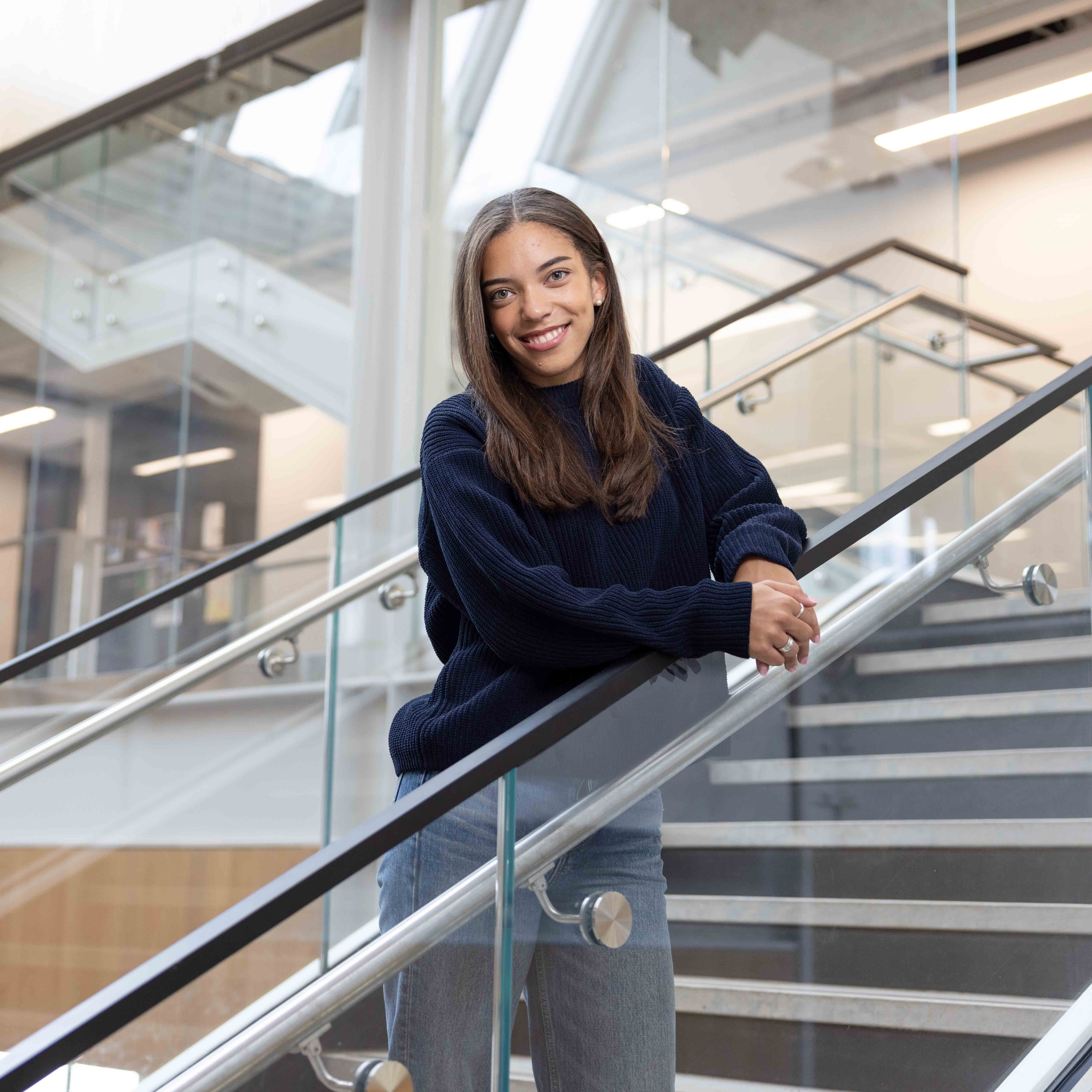
The experience also broadened Sabrina’s perspective.
“It really opened up my outlook on the world,” she says. “Before this, I saw my options as very local. But this showed me there’s so much more support and possibility out there.”
She also began to see engineering through a new lens. “I never realized how much context matters,” she says. “Something that works perfectly in one country might not make sense somewhere else. You have to design with empathy and with an understanding of the people who will use what you create.”
Working on a culturally relevant medical test taught her that the details others might overlook — like the familiarity of a scent or the heat of a climate — can decide whether a design truly works for a community.
That insight, she says, will stay with her long after graduation. “It’s changed the way I think about engineering,” she says. “It’s not just about solving technical problems. It’s about solving human ones.”
A future made possible by donors
Now entering her final year, Sabrina is exploring where this newfound passion might take her. Graduate studies — once something she dismissed as unrealistic — suddenly feel possible.
“Before this, I never saw research or grad school as something I could do,” she says. “Now I see a path forward.”
When she reflects on how far she’s come, Sabrina is quick to credit the donors who are all in on preparing future leaders and global citizens, who made her journey possible.
“This opportunity changed my life,” she says. “It opened doors I didn’t even know existed — academically, personally, and globally. And it happened because people I’ve never met cared enough to give.”
She hopes more students get the same chance — to see their learning come alive, to travel beyond their comfort zone and to understand that science can be an act of service.
Her story is just one of many made possible through donor-funded programs like the USRI program. For Sabrina, it’s proof that a single gift can spark a world of discovery.
“You didn’t just fund a research project,” she says. “You gave me the chance to see what I’m capable of. That’s something I’ll carry with me forever.”
